
Roshan Bhandari
Team Lead · Software Engineer · DevOps
Available for Projects
Conversation Steganography uses local LLMs to encrypt and disguise private messages as innocent chat text, enabling covert communication through any messaging platform.
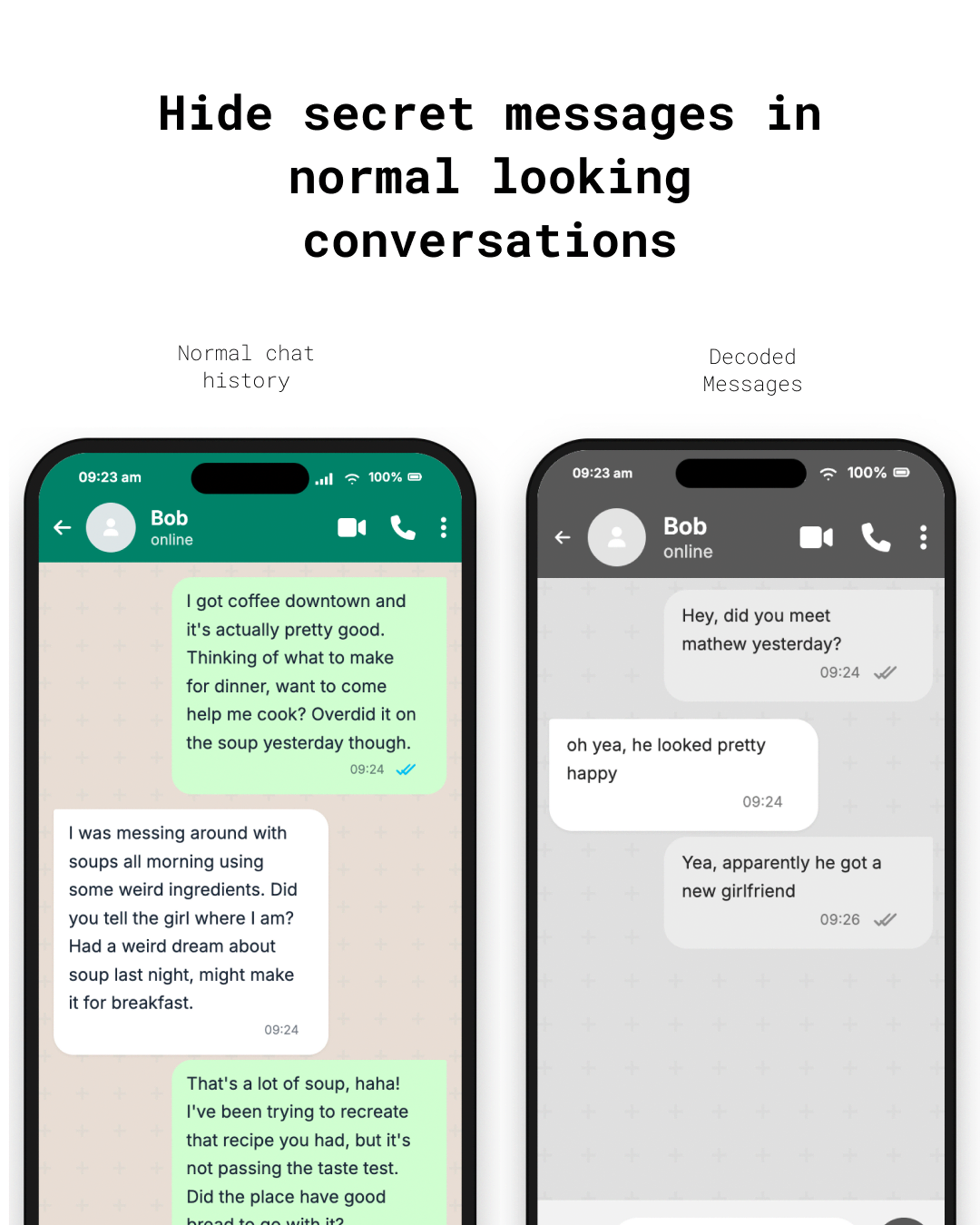
Turn your everyday messaging apps into secure communication channels by embedding encrypted data inside AI-generated cover text that looks completely innocent.
Conversation Steganography is a clever tool that transforms private messages into seemingly normal chat conversations. It works by taking your secret text, encrypting it, and then using a local AI model to generate plausible cover messages that contain your hidden data. The result looks like typical messaging chatter — discussions about recipes, weather, or casual plans — while actually carrying encrypted information between parties.
Unlike traditional encryption that makes messages look suspicious (think scrambled text that screams "I'm hiding something!"), this approach leverages the power of large language models to create natural-sounding cover text. Your messaging platform only ever sees innocent-looking messages, while you and your recipient can decode the true content using the shared secret key.
The practical applications are compelling for privacy-conscious users. Imagine coordinating sensitive information in environments where encrypted messages might draw unwanted attention — whether that's under restrictive regimes, workplace monitoring, or simply wanting an extra layer of privacy. You could discuss meeting times, share personal notes, or coordinate activities while appearing to have completely mundane conversations.
Key capabilities include:
Developers and security researchers can use this as a foundation for exploring steganographic techniques, privacy tools, or understanding how AI can be leveraged for covert communication channels.
With 840 stars and growing interest, this project resonates in our current digital landscape. As governments and institutions increasingly discuss monitoring private communications, tools that enable discreet messaging have gained renewed attention. The project's creator notes they're "18, and not the first person" to explore LLM-based steganography, acknowledging that more sophisticated versions may already exist.
What makes this repository stand out is its accessibility — it transforms a complex cryptographic concept into something tangible and testable. The built-in setup wizard guides users through model selection and configuration, while the simulation feature allows immediate experimentation. However, the project openly acknowledges its limitations, noting that detection techniques are already being developed and positioning itself explicitly as educational rather than production-ready.
This tool is primarily aimed at developers, privacy researchers, and technically curious users interested in steganography and AI applications. You'll need basic command-line comfort and a system capable of running Go applications with local AI models. The setup process includes model recommendations based on your hardware, making it somewhat accessible across different machines.
Importantly, the project carries clear educational-use warnings and cautions about its proof-of-concept status. It's not designed for production security applications, and users should understand that sophisticated analysis techniques may already exist to detect such hidden communications. Think of it as a fascinating exploration of LLM capabilities rather than a foolproof privacy solution.
Ready to experiment? Here's how to get started:
# Clone and build
git clone https://github.com/nethical/conversation-stenography.git
cd conversation-stenography
go build -o conversation-stenography ./cmd/conversation-stenography
Run the application for the first time to launch the setup wizard, which will guide you through model selection and configuration.
./conversation-stenographyTest the functionality with the built-in simulator:
./conversation-stenography simulateFor the full setup guide, see the official repository.